- Study Abroad /
- blog /
- Letter of Motivation for Germany: Sample, Requirements & How to Write It
Letter of Motivation for Germany: Sample, Requirements & How to Write It


Author
01-10-2026

A Letter of Motivation (LOM) is a key document in German University applications, along with your GPA and academic records. The Letter of Motivation explains why you want to pursue that particular programme, what interests you about it, and how it matches your academic background and career goals.
German universities continue to attract international students, with around 420,000 international students and doctoral candidates enrolled in the 2025/26 winter semester, as per the DAAD data (December 2025). With so many students choosing Germany, submitting a well-written LOM is important to show your genuine interest in the specific programme and university.
LOM requirements are not the same across Germany. Universities, programmes, scholarships, and other application processes set different requirements for content, length, format, and submission. In this guide, we will cover what to include in your LOM, how to structure it for bachelor’s and master’s applications, tips, common mistakes and sample LOMs for reference.
At a Glance
|
What is a Letter of Motivation for Germany?
A Letter of Motivation (LOM) is a personal document written by an applicant, addressed to the admission committee to explain why you are applying for a specific opportunity and why you are a strong candidate, beyond what is mentioned in your CV. For a German university application, the LOM explains your motivation for choosing the programme, relevant academic or professional background, and how the programme connects with your future goals. You also highlight what you hope to learn from the programme and how your skills and experience can contribute to the university or academic community.
The term used for this LOM document can vary depending on the institution or application. It may be called a Motivation Letter, Motivationsschreiben, Statement of Purpose (SOP), or Personal Statement. These terms can mean the same thing, but their use and requirements may be different, so applicants should follow the terms and instructions given by the university or organisation.
Types of LOM for Germany
There are different types of LOMs and each has a different purpose. A university LOM focuses on your academic relevancy, a scholarship LOM explains why you need the funding and a visa LOM insists why you want to study in Germany. The major types of LOMs for Germany are:
1. Letter of Motivation for German Universities
A letter of motivation for German Universities is written to the university’s admission committee (UAC) and explains your motivation to study the chosen programme, how your academic background and relevant experiences matches the requirements and how it supports your future career goals.
2. Letter of Motivation for German Scholarships
A letter of motivation for German Scholarships is written to address the scholarship provider for your selected programme and it explains why you are applying for the scholarship and how the funding will support your academic and career plans. Before writing, make sure your LOM is written according to the requirements for your chosen programme as each scholarship programme has different eligibility and selection criteria.
3. Letter of Motivation for a German Student Visa
A letter of motivation for a German student visa is an important part of your visa application. It is submitted to the German Embassy or Consulate and explains why you want to study in Germany, why you chose the programme, and how it connects to your career goals. You can also mention Germany’s strengths in your field, such as research, technology, or sustainable development, and explain how you have planned to implement it in your home country.
LOM vs SOP vs Personal Statement vs Cover Letter vs LOR
As mentioned above, German university applications require different supporting documents, but similar terminology can make it difficult to understand what each document is intended to do. Let's break down the difference between each:
| Document | Where is it commonly used? | Main purpose | What it covers |
| Letter of Motivation (1-2 pages) |
University admissions, scholarships, research programmes | Explain why you want the opportunity and why it fits your goals | Reasons for choosing the programme, university or scholarship; relevant academic and personal experiences; expected benefits; future goals. |
| Statement of Purpose (1-2 pages) |
Particularly for Master's and PhD applications | Explain what you want to study, why, and what you plan to achieve | Academic preparation, subject interests, relevant projects or research experience, reasons for choosing the programme, and future academic or career objectives. |
| Personal Statement (1-2 pages) |
University admissions, scholarships and other selection processes | Present who you are, what shaped you, and what you bring to the application | Personal experiences, significant influences, challenges overcome, values, achievements, and how these have shaped your aspirations. |
| Cover Letter (1-2 pages) |
Jobs, internships and professional applications | Show why you are suitable for and interested in the specific job | Relevant skills, qualifications, work experience, examples of achievements, interest in the company, and suitability for the advertised role. |
| Letter of Recommendation (1-2 pages) |
University admissions, scholarships, research positions and employment | Provide another person's assessment of your abilities, achievements, and potential | The recommender's relationship with the applicant, observed academic or professional performance, specific strengths, achievements, and potential. |
Sample Letter of Motivation for a German University
A good letter of motivation for German Universities should connect your academic background, relevant experiences, reasons for choosing the particular programme, and future goals. A Master’s application requirement is completely different from the one for a Bachelor’s application and the expectation will also vary depending on English-taught and German-taught programmes.
The samples below show what to include in a letter of motivation for Bachelor's and Master's applications to German universities.
Note: Use the letter of motivation for germany sample requirements only to understand the structure and presentation. Don’t copy the sample motivation letter.
What Should a Bachelor's LOM for a German University Include?
As a Bachelor's applicant you might have limited professional or higher-education experience, so the letter of motivation should focus on your school-level academic background, extra curricular activities, personal interests, and the experiences that influenced your decision to pursue the chosen field.
A strong LOM should show why you are interested in the programme and how it relates to your future academic or career plans.
To get a better idea of how to structure your letter, you can refer to our Bachelor's Letter of Motivation sample below.
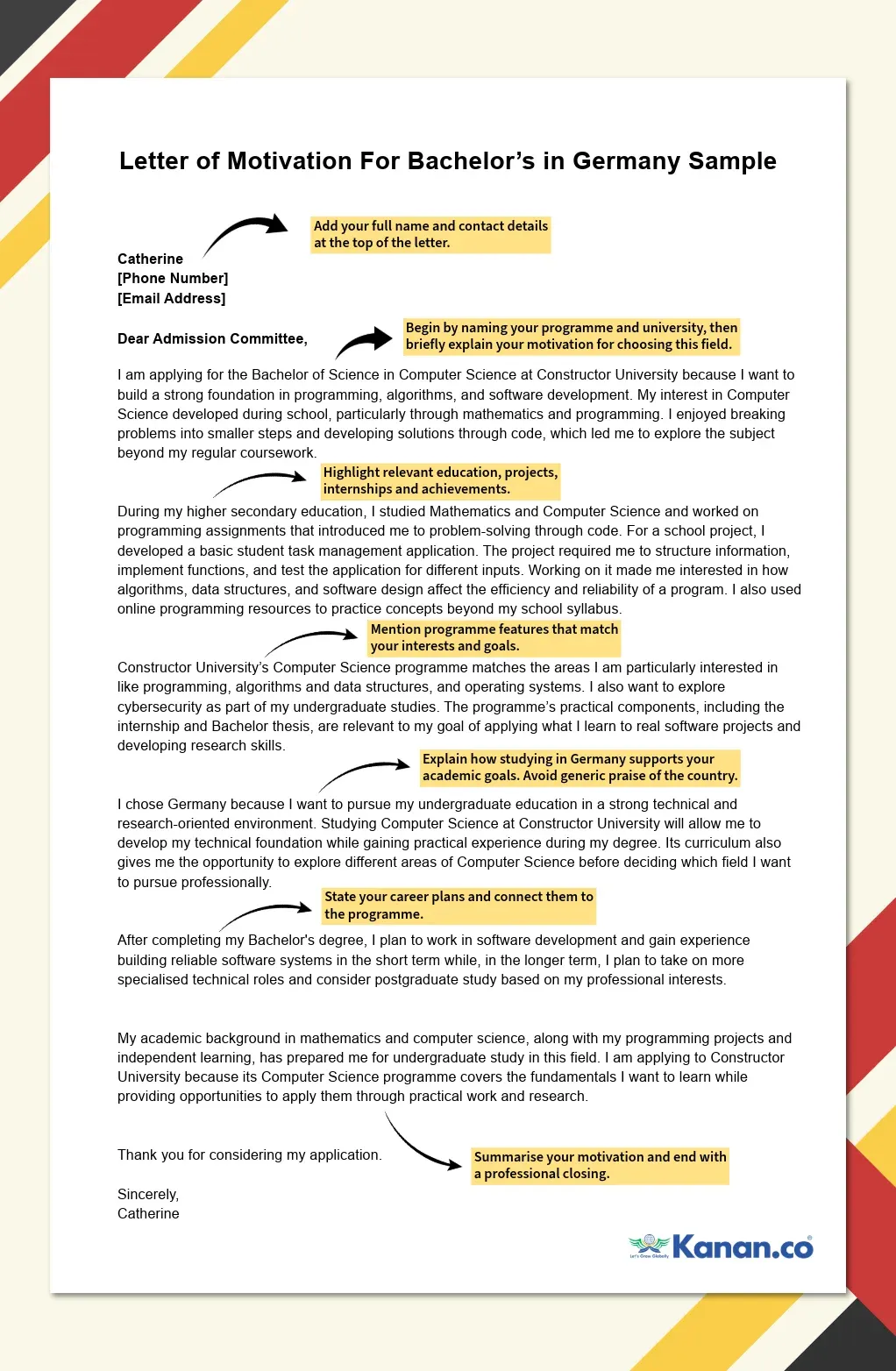
Bachelor's Letter of Motivation Sample PDF
What Should a Master's LOM for a German University Include?
For a Master's application, the expectations are higher because you already have a Bachelor's degree and may also have research, internship, or work experience.
Your LOM should show how your past studies and experiences have prepared you for the Master's programme and why you want to pursue this particular programme in this particular University.
To get a better idea of how to write a letter of motivation for masters in Germany, you can refer to our LOM sample below.
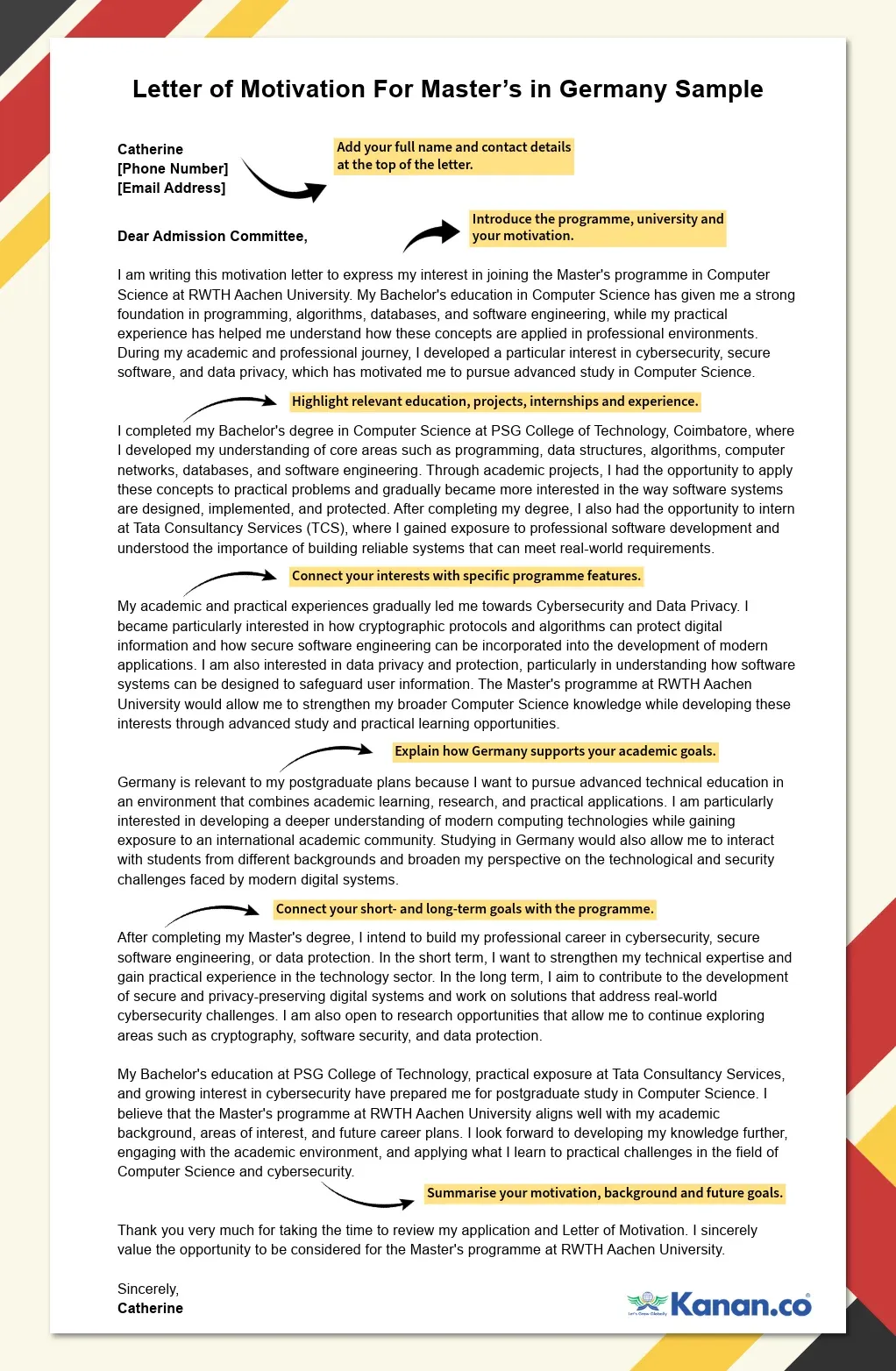
Master's Letter of Motivation Sample PDF
How to Write a Letter of Motivation for a German University?
A strong Letter of Motivation has nothing to do with "bragging". It's about whether it actually has relevance. Instead of simply listing information from your CV, explain how your academic background, projects, or other experiences influenced your decision to choose the programme.
For example, if your extracurricular activities are related to your interest in Germany or your chosen field, they can strengthen your LOM. Taking German language classes or completing a project on German scholarship programme history can demonstrate a relevant interest. While relevant activities such as playing basketball or joining a theatre club may add little value unless you clearly explain how they relate to your application.
Include an experience because it supports your motivation or suitability, not simply because it is an achievement.
The following structure will help you present your background, reasons for choosing the programme and university, and future goals in a clear, logical order:
1. Introduce Yourself and Your Purpose
Start by introducing yourself, mentioning the university and programme you are applying to, and briefly explaining why you want to pursue this field. The introduction must persuade the admission committee about you and your background.
2. Highlight Your Academic Background
Discuss relevant academic qualifications, certificates, projects, research, and achievements that demonstrate your preparation for the chosen programme.
3. Include Relevant Professional Experience
Mention relevant internships, work experience, workshops, volunteering, or practical activities that support your interest in the programme.
4. Explain Your Motivation for the Programme
Describe why you chose the field and how your academic background, personal interests, or previous experiences influenced your decision.
5. Show Why You Chose This University
Show that you have researched the university and programme. Mention specific modules, specialisations, research opportunities, or other features that match your interests and goals.
6. Connect the Programme to Your Future Goals
Explain your short-term and long-term academic or career goals and how completing the programme will help you achieve them.
7. End with a Professional Conclusion
Briefly summarise your motivation and suitability for the programme. End with a professional closing that expresses your interest in being considered for admission.
Essential Formatting & Rules
- Length: Follow the word limit specified by the university or programme. Ideally 1-2 pages.
- Typography: Use professional font like Arial or Times New Roman, with 11-12pt size.
- Tone: Maintain professional, clear, consistent and personal tone throughout the letter.
- Spacing & Margins: Use single-spaced, standard 1-inch margins.
- Header & Salutation: Mention your contact details and date at the top (header), then follow with a formal salutation like “Dear committee members”
- Originality: Write in your own voice and avoid generic statements or copied templates.
- Closing & Signature: Write a formal conclusion and sign at the end.
What are the LOM Requirements for Your University?
LOM requirements can vary by university, programme, degree level, and application type. One programme may ask for a 600-word letter, another may have a character limit, and another may provide specific questions that applicants must answer.
So always check the official guidelines of your chosen university and programme before writing your LOM.
Guidelines Provided by German Universities for Writing a LOM
The list below shows how some German universities provide official guidelines for writing a Letter of Motivation (LOM) and what they expect the applicants to include.
| University | City | Status | Guideline | Scope |
| LMU Munich | Munich | Public | Guideline | Career & Work |
| Heidelberg University | Heidelberg | Public | Guideline | Study Programme |
| Goethe University Frankfurt | Frankfurt | Public | Guideline | Internship |
| University College Freiburg | Freiburg | Public | Guideline | Study Programme |
10 Tips for Your Letter of Motivation
Now you know that LOM requirements may vary between universities; here are some helpful tips to help you write a clear motivation letter.
1. Start Strong
Begin with a clear statement about who you are, what you are applying for, and why. Avoid general statements and get to the main point quickly.
2. Use a Professional, Neutral Writing Style
Use clear and professional language throughout your LOM. Avoid funny or dramatic statements that do not add value to your application.
3. Be Specific About the Programme and University
Show that you have researched the programme and university. Mention relevant modules, specialisations, and research areas from the programme that match your interests and goals.
4. Link Everything Back to the Programme
Connect every experience, achievement, or skill you mention to the programme you choose to show why you are a good fit for the programme.
5. Be Honest
Admission staff will notice if anything looks over exaggerated. So try to present your actual qualifications, experiences, and goals transparently and avoid information that does not reflect your real background.
6. Use AI Carefully
You can use AI for grammar, proofreading, and clarity, but it should not replace your own writing. Your LOM should reflect your genuine experiences and motivation, in your personal voice.
7. Check for Consistency
Read the complete letter to make sure your information connects logically. Make sure your academic background, experiences, motivation, and future goals do not contradict each other.
8. Note the Language Requirement
Check whether the university requires your LOM in English or German. If a German-language letter is required, have it reviewed by someone who is fluent in German.
9. Follow the University Requirements
Check the official application instructions before writing. Follow the required word limit, format, content, language, and submission requirements.
10. Start Early and Revise
Start your LOM well before the application deadline. Allow enough time to write, review, proofread, and revise your letter before submission.
Common Mistakes to Avoid in a Letter of Motivation for Germany
Avoid these common mistakes when writing your LOM:
- Avoid including too much personal information that is not relevant to your course or career goals.
- Avoid copying and pasting generic templates. Instead write your own LOM reflecting your personal journey.
- Avoid using overly casual language which reduces the professional impact of your LOM.
- Avoid submitting your LOM with spelling and grammatical errors. Always proofread before you submit your letter.
- Avoid simply repeating your CV. Instead explain how your experience connects to your chosen programme.
If you’re planning to study in Germany and need guidance with your university applications, get consultancy from our leading study abroad mentors at Kanan.co and make your study abroad journey easier.
Frequently Asked Questions
1. Do German Universities Require a Letter of Motivation?
Yes, many German Universities require a Letter of Motivation, but it depends on the programme. Always check the official programme page to confirm the requirements, word limit, format and any university specific requirements.
2. What should I include in my motivation letter for a German language visa application?
In your letter of motivation for Germany visa you must include why you have chosen Germany and the particular programme, your relevant academic background, how it supports your career goals and what you are going to do after the programme.
3. Do You Need a Letter of Motivation for Ausbildung in Germany?
Yes, a Letter of Motivation is commonly required for an Ausbildung in Germany. It should explain why you have chosen the particular vocational training programme, your relevant education or experience, why you are interested in the field, and how the Ausbildung fits into your career plans.
4. What is the difference between a cover letter and a motivation letter?
A cover letter focuses mainly on your skills and work experience while a motivation letter explains your interests, goals and reasons for applying to that particular programme.
5. Do I need a Letter of Motivation for a PhD in Germany?
Many PhD programmes and doctoral positions in Germany require a Letter of Motivation, but the requirements may vary by universities and programmes.
6. Do Internships in Germany Require a Letter of Motivation?
Not really. Some internships in Germany require a letter of motivation (Motivationsschreiben) while some require a well-crafted cover letter (Anschreiben), depending on the company or program.
About Author Roshan Sunthar
Roshan Sunthar is a study abroad expert as well as a renowned writer and author in international education. His academic excellence and 5+ years of work experience give him in-depth knowledge of international standardised exams and test preparation in IELTS, TOEFL, GRE, PTE, SAT, etc. The study materials he prepares incorporate exam-like questions. He’s also an expert in writing Statement of Purposes (SOPs) and Letter of Recommendations (LORs) for college admissions. He usually spends his leisure time watching English classics and documentaries, travelling, etc.

Kanan.co is a trusted study abroad consultancy offering comprehensive services, resources, and solutions for students and education institutions. We support students at every stage of their global education journey, ensuring a smooth and guided experience. Along with test preparation for IELTS, GRE, TOEFL, and SAT, we provide expert services such as SOP writing, visa guidance, accommodation support, scholarship assistance, and education loan support. Our expertise and commitment to excellence make us a reliable partner for students pursuing international education.
Get Germany Admission Counselling by Experts





Global Headquarters
Kanan Int EdTech Inc
320 Bay Street, Suite 321 (Spaces), Toronto ON, Canada M5B 1N9
Indian Headquarters
Kanan International Pvt. Ltd.
D-wing, 2nd Floor, Trident Complex, Ellora Park Vadiwadi Road, Vadodara, Gujarat 390007
IT/ Digital Campus
Kanan International Pvt. Ltd
Old, New No 3, 2nd Floor, 1A, Dr Sadasivam Rd, T. Nagar, Chennai, Tamil Nadu 600017
Our branches
- Bardoli
- Bharuch
- Chennai
- Dehradun
- Gurugram
- Himatnagar
- Karnal
- Nadiad
- Navsari
- Palanpur
- Rajkot
- Vadodara
- Valsad
- Vallabh Vidyanagar
- Vapi
Study Abroad
Test Prep
Top Universities
Consultants
IELTS Centers
GRE Centers
TOEFL Centers
SAT Centers
Language Courses in Vadodara
Study Abroad Calculators
Featured Blogs
Study Abroad Consultants in Chennai
Study Abroad Consultants in Surat
Study Abroad Consultants in Navsari
Study Abroad Consultants in Bardoli
Study Abroad Consultants in Ahmedabad
Study Abroad Consultants in Anand
Study Abroad Consultants in Khanna
Study Abroad Consultants in Nadiad
Study Abroad Consultants in Vadodara
Study abroad consultants in Valsad
Copyright © 2026 KANAN.CO All rights reserved.